Chemie-Richtlinien: Unterschied zwischen den Versionen
| Zeile 20: | Zeile 20: | ||
:''Beispiel 1.1: SBNr. 175046, Seite 28, 29, 99, 48:'' | :''Beispiel 1.1: SBNr. 175046, Seite 28, 29, 99, 48:'' | ||
:[[Datei:1 Ignorieren der Tiefstellung.png|350px]] | :[[Datei:1 Ignorieren der Tiefstellung.png|350px]] | ||
| − | {| width="98%" style="float:right; border-style:solid; border-width:0.5px; border-color:#ffffff; background-color: #DBE5F1; padding-left:2em; padding: 5px 15px; font-family: | + | {| width="98%" style="float:right; border-style:solid; border-width:0.5px; border-color:#ffffff; background-color: #DBE5F1; padding-left:2em; padding: 5px 15px; font-family:Courier new; font-size:14px; line-height: 150%; padding: 1px;" |
| | | | ||
:H2O; O2; H2; CH4; Mg(OH)2; C3H5(OH)3 | :H2O; O2; H2; CH4; Mg(OH)2; C3H5(OH)3 | ||
| Zeile 43: | Zeile 43: | ||
:[[Datei:2. Anzahl von Mikroteilchen.png|250px]] | :[[Datei:2. Anzahl von Mikroteilchen.png|250px]] | ||
| − | {| width="98%" style="float:right; border-style:solid; border-width:0.5px; border-color:#ffffff; background-color: #DBE5F1; padding-left:2em; padding: 5px 15px; font-family: | + | {| width="98%" style="float:right; border-style:solid; border-width:0.5px; border-color:#ffffff; background-color: #DBE5F1; padding-left:2em; padding: 5px 15px; font-family:Courier new; font-size:14px; line-height: 150%; padding: 1px;" |
| | | | ||
:2 Mg; 2 C2H5OH; 2 e^(-) | :2 Mg; 2 C2H5OH; 2 e^(-) | ||
|} | |} | ||
| − | + | {| | |
| + | {|width="100%" | ||
| + | |} | ||
| + | <br> | ||
:[[Datei:2. Anzahl von Mikroteilchen 2.png|300px]] | :[[Datei:2. Anzahl von Mikroteilchen 2.png|300px]] | ||
| − | {| width="98%" style="float:right; border-style:solid; border-width:0.5px; border-color:#ffffff; background-color: #DBE5F1; padding-left:2em; padding: 5px 15px; font-family: | + | {| width="98%" style="float:right; border-style:solid; border-width:0.5px; border-color:#ffffff; background-color: #DBE5F1; padding-left:2em; padding: 5px 15px; font-family:Courier new; font-size:14px; line-height: 150%; padding: 1px;" |
| | | | ||
:6 CO2 +6 H2O -> C6H12O6 +6 O2 | :6 CO2 +6 H2O -> C6H12O6 +6 O2 | ||
| Zeile 75: | Zeile 78: | ||
:[[Datei:3. Zusatzangaben zu Formeln.png|300px]] | :[[Datei:3. Zusatzangaben zu Formeln.png|300px]] | ||
| − | {| width="98%" style="float:right; border-style:solid; border-width:0.5px; border-color:#ffffff; background-color: #DBE5F1; padding-left:2em; padding: 5px 15px; font-family: | + | {| width="98%" style="float:right; border-style:solid; border-width:0.5px; border-color:#ffffff; background-color: #DBE5F1; padding-left:2em; padding: 5px 15px; font-family:Courier new; font-size:14px; line-height: 150%; padding: 1px;" |
| | | | ||
:C2H5OH(l) +3 O2(g) -> 2 CO2(g) +3 H2O(l) | :C2H5OH(l) +3 O2(g) -> 2 CO2(g) +3 H2O(l) | ||
| Zeile 81: | Zeile 84: | ||
{|width="100%" | {|width="100%" | ||
|} | |} | ||
| − | + | <br> | |
| − | |||
:''Beispiel 3.2: SBNr. 195115, Seite 62:'' | :''Beispiel 3.2: SBNr. 195115, Seite 62:'' | ||
:[[Datei:3. Zusatzangaben zu Formeln 2.png|400px]] | :[[Datei:3. Zusatzangaben zu Formeln 2.png|400px]] | ||
| − | {| width="98%" style="float:right; border-style:solid; border-width:0.5px; border-color:#ffffff; background-color: #DBE5F1; padding-left:2em; padding: 5px 15px; font-family: | + | {| width="98%" style="float:right; border-style:solid; border-width:0.5px; border-color:#ffffff; background-color: #DBE5F1; padding-left:2em; padding: 5px 15px; font-family:Courier new; font-size:14px; line-height: 150%; padding: 1px;" |
| | | | ||
:MgCl2(s) -> Mg^(2+)(l) +2 Cl^(-)(l) | :MgCl2(s) -> Mg^(2+)(l) +2 Cl^(-)(l) | ||
| Zeile 95: | Zeile 97: | ||
{|width="100%" | {|width="100%" | ||
|} | |} | ||
| − | + | <br> | |
| − | |||
:''Beispiel 3.3: SBNr. 195115, Seite 62:'' | :''Beispiel 3.3: SBNr. 195115, Seite 62:'' | ||
:[[Datei:3. Zusatzangaben zu Formeln 3.png|550px]] | :[[Datei:3. Zusatzangaben zu Formeln 3.png|550px]] | ||
| − | {| width="98%" style="float:right; border-style:solid; border-width:0.5px; border-color:#ffffff; background-color: #DBE5F1; padding-left:2em; padding: 5px 15px; font-family: | + | {| width="98%" style="float:right; border-style:solid; border-width:0.5px; border-color:#ffffff; background-color: #DBE5F1; padding-left:2em; padding: 5px 15px; font-family:Courier new; font-size:14px; line-height: 150%; padding: 1px;" |
| | | | ||
: In der Formelschreibweise ... | : In der Formelschreibweise ... | ||
| Zeile 127: | Zeile 128: | ||
:[[Datei:4. Kristallwasser.png|200px]] | :[[Datei:4. Kristallwasser.png|200px]] | ||
| − | {| width="98%" style="float:right; border-style:solid; border-width:0.5px; border-color:#ffffff; background-color: #DBE5F1; padding-left:2em; padding: 5px 15px; font-family: | + | {| width="98%" style="float:right; border-style:solid; border-width:0.5px; border-color:#ffffff; background-color: #DBE5F1; padding-left:2em; padding: 5px 15px; font-family:Courier new; font-size:14px; line-height: 150%; padding: 1px;" |
| | | | ||
:--- | :--- | ||
| Zeile 176: | Zeile 177: | ||
:[[Datei:5. Hintere Indices.png|300px]] | :[[Datei:5. Hintere Indices.png|300px]] | ||
| − | {| width="98%" style="float:right; border-style:solid; border-width:0.5px; border-color:#ffffff; background-color: #DBE5F1; padding-left:2em; padding: 5px 15px; font-family: | + | {| width="98%" style="float:right; border-style:solid; border-width:0.5px; border-color:#ffffff; background-color: #DBE5F1; padding-left:2em; padding: 5px 15px; font-family:Courier new; font-size:14px; line-height: 150%; padding: 1px;" |
| | | | ||
:CH3COOH +H2O -> CH3COO^(-) +H3O^(+) | :CH3COOH +H2O -> CH3COO^(-) +H3O^(+) | ||
| Zeile 182: | Zeile 183: | ||
{|width="100%" | {|width="100%" | ||
|} | |} | ||
| − | + | <br> | |
| − | |||
:''Beispiel 5.2: SBNr. 195115, Seite 90; Sonderzeichen (Bedeutung einer Funktion):'' | :''Beispiel 5.2: SBNr. 195115, Seite 90; Sonderzeichen (Bedeutung einer Funktion):'' | ||
:[[Datei:5. Hintere Indices 2.png|280px]] | :[[Datei:5. Hintere Indices 2.png|280px]] | ||
| − | {| width="98%" style="float:right; border-style:solid; border-width:0.5px; border-color:#ffffff; background-color: #DBE5F1; padding-left:2em; padding: 5px 15px; font-family: | + | {| width="98%" style="float:right; border-style:solid; border-width:0.5px; border-color:#ffffff; background-color: #DBE5F1; padding-left:2em; padding: 5px 15px; font-family:Courier new; font-size:14px; line-height: 150%; padding: 1px;" |
| | | | ||
:'De(H_R) ='Si(H_(Produkte)) -'Si(H_(Edukte)) | :'De(H_R) ='Si(H_(Produkte)) -'Si(H_(Edukte)) | ||
| Zeile 203: | Zeile 203: | ||
:''Beispiel 6.1:'' | :''Beispiel 6.1:'' | ||
:[[Datei:6. Radikale 2.png|400px]] | :[[Datei:6. Radikale 2.png|400px]] | ||
| − | {| width="98%" style="float:right; border-style:solid; border-width:0.5px; border-color:#ffffff; background-color: #DBE5F1; padding-left:2em; padding: 5px 15px; font-family: | + | {| width="98%" style="float:right; border-style:solid; border-width:0.5px; border-color:#ffffff; background-color: #DBE5F1; padding-left:2em; padding: 5px 15px; font-family:Courier new; font-size:14px; line-height: 150%; padding: 1px;" |
| | | | ||
:R'. | :R'. | ||
| Zeile 211: | Zeile 211: | ||
{|width="100%" | {|width="100%" | ||
|} | |} | ||
| − | + | <br> | |
| − | |||
:''Beispiel 6.2: SBNr.: 160742, Seite: 256/257'' | :''Beispiel 6.2: SBNr.: 160742, Seite: 256/257'' | ||
:[[Datei:6. Radikale.png|300px]] | :[[Datei:6. Radikale.png|300px]] | ||
| − | {| width="98%" style="float:right; border-style:solid; border-width:0.5px; border-color:#ffffff; background-color: #DBE5F1; padding-left:2em; padding: 5px 15px; font-family: | + | {| width="98%" style="float:right; border-style:solid; border-width:0.5px; border-color:#ffffff; background-color: #DBE5F1; padding-left:2em; padding: 5px 15px; font-family:Courier new; font-size:14px; line-height: 150%; padding: 1px;" |
| | | | ||
:|Typischer Verbrennungsverlauf| | :|Typischer Verbrennungsverlauf| | ||
| Zeile 236: | Zeile 235: | ||
|} | |} | ||
<br> | <br> | ||
| − | + | ||
==7. Oxidationszahlen== | ==7. Oxidationszahlen== | ||
{|width="100%" | {|width="100%" | ||
| Zeile 246: | Zeile 245: | ||
:[[Datei:7. Oxidationszahlen.png|300px]] | :[[Datei:7. Oxidationszahlen.png|300px]] | ||
| − | {| width="98%" style="float:right; border-style:solid; border-width:0.5px; border-color:#ffffff; background-color: #DBE5F1; padding-left:2em; padding: 5px 15px; font-family: | + | {| width="98%" style="float:right; border-style:solid; border-width:0.5px; border-color:#ffffff; background-color: #DBE5F1; padding-left:2em; padding: 5px 15px; font-family:Courier new; font-size:14px; line-height: 150%; padding: 1px;" |
| | | | ||
:<nowiki>{{</nowiki>Die mit ' gekennzeichnete Zahl in der Klammer ist jeweils die Zahl, die über dem davor stehenden Buchstaben steht.<nowiki>}}</nowiki> | :<nowiki>{{</nowiki>Die mit ' gekennzeichnete Zahl in der Klammer ist jeweils die Zahl, die über dem davor stehenden Buchstaben steht.<nowiki>}}</nowiki> | ||
| Zeile 266: | Zeile 265: | ||
{| width="98%" style="float: right; border-style:solid; border-width:2px; border-color:#DBE5F1; padding: 5px; " | {| width="98%" style="float: right; border-style:solid; border-width:2px; border-color:#DBE5F1; padding: 5px; " | ||
| | | | ||
| − | Abs. | + | Abs.8) Klammersetzung eines Indexinhalts immer, wenn das Lesen der Indices schwierig werden könnte. |
::Vor dem ^ als vorderen Index immer einen Abstand lassen, damit keine Verwechslungsgefahr mit ^ als Hochzahl besteht. Die Zahl danach in Klammer setzen (außer die Null, wenn damit der Durchschnitt bzw. Standard gemeint ist - siehe Kapitel "Durchschnitt; Standard). | ::Vor dem ^ als vorderen Index immer einen Abstand lassen, damit keine Verwechslungsgefahr mit ^ als Hochzahl besteht. Die Zahl danach in Klammer setzen (außer die Null, wenn damit der Durchschnitt bzw. Standard gemeint ist - siehe Kapitel "Durchschnitt; Standard). | ||
| Zeile 272: | Zeile 271: | ||
::Untere vorderer Index immer mit _ ankündigen und die Zahl in Klammer setzen. | ::Untere vorderer Index immer mit _ ankündigen und die Zahl in Klammer setzen. | ||
| − | : | + | :8.1) Massen- und Ordnungszahl eines Elements oder Atommasse und Ordnungszahl des Elements sind angegeben |
::Abstand, Symbol für oberen Index "^", dann den Index in Klammern, dann gleich danach Symbol für hinteren Index "_" und den unterer Index in Klammer, dann das Elementsymbol | ::Abstand, Symbol für oberen Index "^", dann den Index in Klammern, dann gleich danach Symbol für hinteren Index "_" und den unterer Index in Klammer, dann das Elementsymbol | ||
{|width="100%" | {|width="100%" | ||
| Zeile 278: | Zeile 277: | ||
:::''Beispiel:'' | :::''Beispiel:'' | ||
:::[[Datei:8. Molekül Atom mit vielen Indices.png|30px]] | :::[[Datei:8. Molekül Atom mit vielen Indices.png|30px]] | ||
| − | {| width="98%" style="float:right; border-style:solid; border-width:0.5px; border-color:#ffffff; background-color: #DBE5F1; padding-left:2em; padding: 5px 15px; font-family: | + | {| width="98%" style="float:right; border-style:solid; border-width:0.5px; border-color:#ffffff; background-color: #DBE5F1; padding-left:2em; padding: 5px 15px; font-family:Courier new; font-size:14px; line-height: 150%; padding: 1px;" |
| | | | ||
::^(12)_(6)C | ::^(12)_(6)C | ||
| Zeile 286: | Zeile 285: | ||
{|width="100%" | {|width="100%" | ||
|} | |} | ||
| − | : | + | :8.2) Massen- und Ordnungszahl eines Elements oder Atommasse und Ordnungszahl des Elements sind angegeben |
::Abstand, Symbol für oberen Index "^", dann den Index in Klammern, dann gleich danach Symbol für hinteren Index "_" und den unterer Index in Klammer, dann das Elementsymbol | ::Abstand, Symbol für oberen Index "^", dann den Index in Klammern, dann gleich danach Symbol für hinteren Index "_" und den unterer Index in Klammer, dann das Elementsymbol | ||
{|width="100%" | {|width="100%" | ||
|} | |} | ||
| + | <br> | ||
:::''Beispiel:'' | :::''Beispiel:'' | ||
:::[[Datei:8. Molekül Atom mit vielen Indices 1.png|250px]] | :::[[Datei:8. Molekül Atom mit vielen Indices 1.png|250px]] | ||
| − | {| width="98%" style="float:right; border-style:solid; border-width:0.5px; border-color:#ffffff; background-color: #DBE5F1; padding-left:2em; padding: 5px 15px; font-family: | + | {| width="98%" style="float:right; border-style:solid; border-width:0.5px; border-color:#ffffff; background-color: #DBE5F1; padding-left:2em; padding: 5px 15px; font-family:Courier new; font-size:14px; line-height: 150%; padding: 1px;" |
| | | | ||
::Gold: ^(197,0)Au^(79) | ::Gold: ^(197,0)Au^(79) | ||
| Zeile 300: | Zeile 300: | ||
{|width="100%" | {|width="100%" | ||
|} | |} | ||
| − | : | + | :8.3) Elementangaben mit bis zu 4 Indices |
::alle Indices in Klammern - Reihung entsprechend den Richtlinien | ::alle Indices in Klammern - Reihung entsprechend den Richtlinien | ||
| Zeile 307: | Zeile 307: | ||
|} | |} | ||
<br> | <br> | ||
| − | :''Beispiel | + | :''Beispiel 8.1: SBNr. 195115, Seite 167:'' |
:''Atommasse und Ordnungszahl sind in dieser Vorlage als obere Indices angegeben.'' | :''Atommasse und Ordnungszahl sind in dieser Vorlage als obere Indices angegeben.'' | ||
:[[Datei:8. Molekül Atom mit vielen Indices 1.png|250px]] | :[[Datei:8. Molekül Atom mit vielen Indices 1.png|250px]] | ||
| − | {| width="98%" style="float:right; border-style:solid; border-width:0.5px; border-color:#ffffff; background-color: #DBE5F1; padding-left:2em; padding: 5px 15px; font-family: | + | {| width="98%" style="float:right; border-style:solid; border-width:0.5px; border-color:#ffffff; background-color: #DBE5F1; padding-left:2em; padding: 5px 15px; font-family:Courier new; font-size:14px; line-height: 150%; padding: 1px;" |
| | | | ||
:<nowiki>---</nowiki> | :<nowiki>---</nowiki> | ||
| Zeile 325: | Zeile 325: | ||
{|width="100%" | {|width="100%" | ||
|} | |} | ||
| − | + | <br> | |
| − | + | :''Beispiel 8.2: nicht aus einem Schulbuch,'' | |
| − | |||
| − | |||
| − | :''Beispiel | ||
:''Genaue Beschreibung eines geladenen Moleküls:'' | :''Genaue Beschreibung eines geladenen Moleküls:'' | ||
:[[Datei:8. Molekül Atom mit vielen Indices 2.png|100px]] | :[[Datei:8. Molekül Atom mit vielen Indices 2.png|100px]] | ||
| − | {| width="98%" style="float:right; border-style:solid; border-width:0.5px; border-color:#ffffff; background-color: #DBE5F1; padding-left:2em; padding: 5px 15px; font-family: | + | {| width="98%" style="float:right; border-style:solid; border-width:0.5px; border-color:#ffffff; background-color: #DBE5F1; padding-left:2em; padding: 5px 15px; font-family:Courier new; font-size:14px; line-height: 150%; padding: 1px;" |
| | | | ||
:^(32)_(16)S2^(2+) | :^(32)_(16)S2^(2+) | ||
| Zeile 355: | Zeile 352: | ||
{| width="98%" style="float: right; border-style:solid; border-width:2px; border-color:#DBE5F1; padding: 5px; " | {| width="98%" style="float: right; border-style:solid; border-width:2px; border-color:#DBE5F1; padding: 5px; " | ||
| | | | ||
| − | Abs. | + | Abs.9) keine Abstände zwischen der Angabe der Schale und der Anzahl der Elektronen in einem bestimmten Orbital (bzw. Hybridorbital) |
:1s; 2s; 2p_x; 2p_y; 2p_z; 3s; 3p_x; 3p_y; 3p_z; 3d_(xy); ... | :1s; 2s; 2p_x; 2p_y; 2p_z; 3s; 3p_x; 3p_y; 3p_z; 3d_(xy); ... | ||
| Zeile 363: | Zeile 360: | ||
|} | |} | ||
<br> | <br> | ||
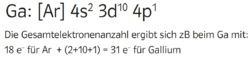
| − | :''Beispiel | + | :''Beispiel 9.1: SBNr. 195115, Seite 22:'' |
:''mit Bezug auf Elektronenkonfiguration eines anderen Elements'' | :''mit Bezug auf Elektronenkonfiguration eines anderen Elements'' | ||
:[[Datei:9. Elektronenkonfiguration Seite 22.png|250px]] | :[[Datei:9. Elektronenkonfiguration Seite 22.png|250px]] | ||
| − | {| width="98%" style="float:right; border-style:solid; border-width:0.5px; border-color:#ffffff; background-color: #DBE5F1; padding-left:2em; padding: 5px 15px; font-family: | + | {| width="98%" style="float:right; border-style:solid; border-width:0.5px; border-color:#ffffff; background-color: #DBE5F1; padding-left:2em; padding: 5px 15px; font-family:Courier new; font-size:14px; line-height: 150%; padding: 1px;" |
| | | | ||
:Ga: [Ar] 4s2 3d10 4p1 | :Ga: [Ar] 4s2 3d10 4p1 | ||
| Zeile 374: | Zeile 371: | ||
{|width="100%" | {|width="100%" | ||
|} | |} | ||
| − | + | <br> | |
| − | + | :''Beispiel 9.2: SBNr. 195115, Seite 40:'' | |
| − | |||
| − | |||
| − | :''Beispiel | ||
:''mit Hybridorbital'' | :''mit Hybridorbital'' | ||
:[[Datei:9. Elektronenkonfiguration 2.png|300px]] | :[[Datei:9. Elektronenkonfiguration 2.png|300px]] | ||
| − | {| width="98%" style="float:right; border-style:solid; border-width:0.5px; border-color:#ffffff; background-color: #DBE5F1; padding-left:2em; padding: 5px 15px; font-family: | + | {| width="98%" style="float:right; border-style:solid; border-width:0.5px; border-color:#ffffff; background-color: #DBE5F1; padding-left:2em; padding: 5px 15px; font-family:Courier new; font-size:14px; line-height: 150%; padding: 1px;" |
| | | | ||
:Elektronenkonfiguration von C: 1s2 2(sp3)4 | :Elektronenkonfiguration von C: 1s2 2(sp3)4 | ||
| Zeile 387: | Zeile 381: | ||
{|width="100%" | {|width="100%" | ||
|} | |} | ||
| − | :[[Datei:9. Elektronenkonfiguration 3.png|350px]] | + | ::[[Datei:9. Elektronenkonfiguration 3.png|350px]] |
<br> | <br> | ||
Version vom 16. Februar 2022, 10:02 Uhr
Inhaltsverzeichnis
Allgemeine Hinweise
Übertragung für Chemie abweichend von/ergänzend zu den Mathematikübertragungsrichtlinien
1. Ignorieren der Tiefstellung bei Formeln
|
Abs.1) Ein Tiefgestellter Index für die Anzahl von Atomen wird nicht als solcher angeben. (Dann gibt es bei Zusatzindizes kein Problem.) |
- Beispiel 1.1: SBNr. 175046, Seite 28, 29, 99, 48:


|
2. Anzahl von Mikroteilchen
|
Abs.2) Nach Angabe der Mengeneinheiten von Atomen, Molekülen, Elektronen... kommt immer ein Abstand |
- Beispiel 2.1: SBNr. 175046, Seite 43, 48, 99:

|

|
3. Zusatzangaben zu Formeln (Aggregatzustände)
|
Abs.3) nicht als Index, sondern nur in runden Klammern
|
- Beispiel 3.1: SBNr. 195115, Seite 97:

|
- Beispiel 3.2: SBNr. 195115, Seite 62:

|
- Beispiel 3.3: SBNr. 195115, Seite 62:

|
4. Kristallwasser
|
Abs.4) mit Punkt ohne Abstände angeben
|
- Beispiel 4.1: SBNr. 195115, Seite 62:

|
5. Hintere Indices
|
Abs.5)
|
- Beispiel 5.1: SBNr. 195115, Seite 81; Ionen:

|
- Beispiel 5.2: SBNr. 195115, Seite 90; Sonderzeichen (Bedeutung einer Funktion):

|
6. Radikale
- Radikal '.
- Beispiel 6.1:


|
- Beispiel 6.2: SBNr.: 160742, Seite: 256/257

|
7. Oxidationszahlen
- Beispiel 7.1: SBNr.: 160742, Seite: 233

|
8. Molekül/Atom mit vielen Indices
|
Abs.8) Klammersetzung eines Indexinhalts immer, wenn das Lesen der Indices schwierig werden könnte.
|


- Beispiel 8.1: SBNr. 195115, Seite 167:
- Atommasse und Ordnungszahl sind in dieser Vorlage als obere Indices angegeben.
|
- Beispiel 8.2: nicht aus einem Schulbuch,
- Genaue Beschreibung eines geladenen Moleküls:

|
- Bedeutung: doppelt positiv geladenes Molekül bestehend aus 2 Schwefelatomen, jedes hat die Massenzahl 32 und die Ordnungszahl 16.
- Massenzahl als vorderen oberen Index
- Ordnungszahl als vorderen unteren Index
- Anzahl der Atome in einem Molekül direkt neben dem Symbol - nicht tiefgestellt (nach den allgemeinen Regeln würde sonst die Anzahl der Atome nach hinten rutschen und die Deutbarkeit erschweren)
- Ladungszahl als hinteren oberen Index
9. Elektronenkonfiguration
|
Abs.9) keine Abstände zwischen der Angabe der Schale und der Anzahl der Elektronen in einem bestimmten Orbital (bzw. Hybridorbital)
|
- Beispiel 9.1: SBNr. 195115, Seite 22:
- mit Bezug auf Elektronenkonfiguration eines anderen Elements

|
- Beispiel 9.2: SBNr. 195115, Seite 40:
- mit Hybridorbital


|

